
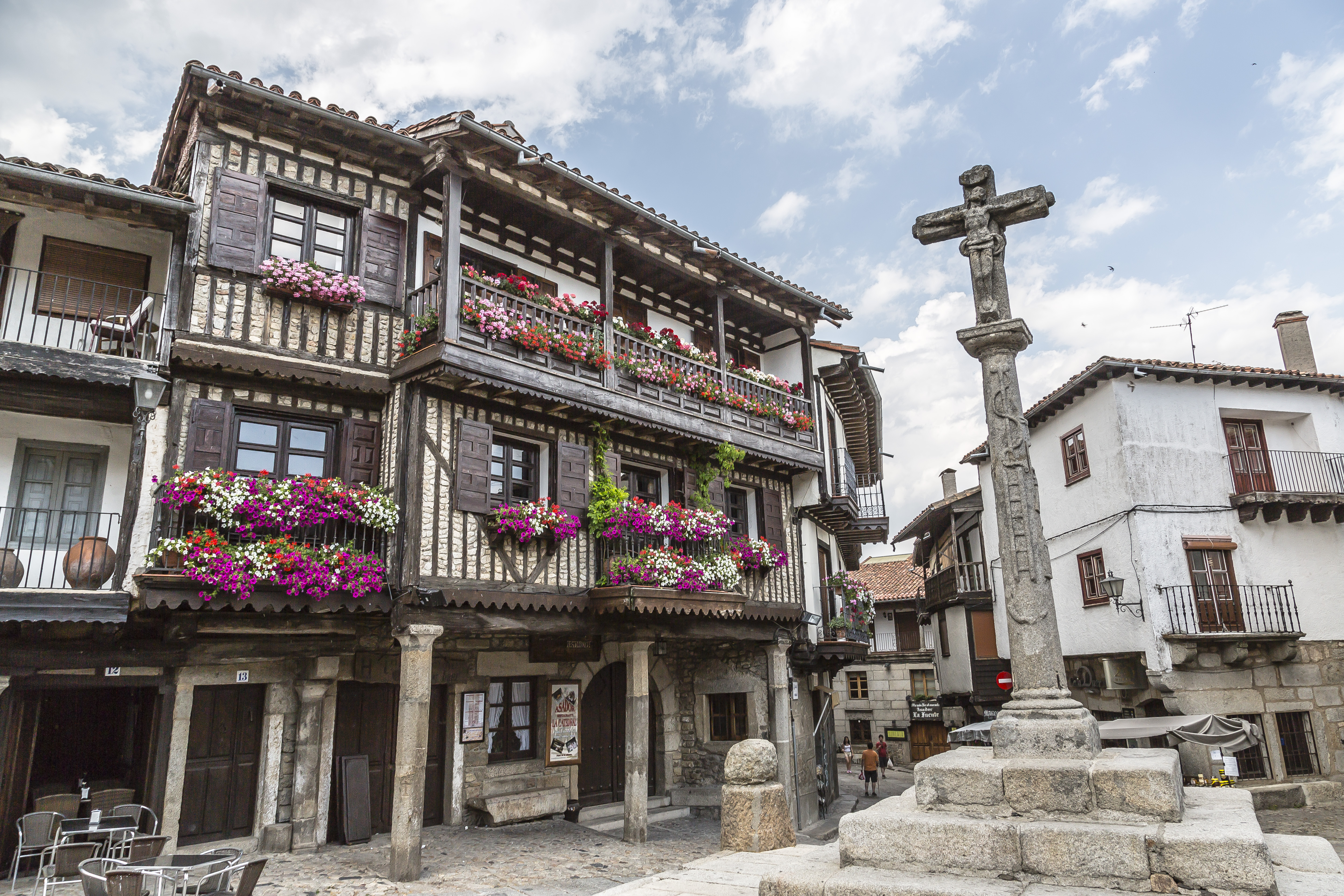
The Pueblo of La Alberca in Salamanca, Spain
A Week in a Small Pueblo in Northern Spain
[/text_output][gap size=”30px” id=”” class=”” style=””][text_output]If you love traveling to small, off the beaten path villages and truly experiencing a language and culture, you will love La Alberca in the Salamanca region of Northern Spain.
Recently I attended Pueblo Espanol’s 8 Day Immersion program in this tiny village and I learned SO much during my time there. Not only did I speak Spanish more continuously (even if not correctly) and fluidly than ever before in my life (100 % Spanish every hour of every day including meals and entertainment), but I also got to live life in a small Spanish village and experience some Spanish traditions first hand.
While I’ve spent a lot of time in Spain over the past year and a half (my fiancee is Spanish and I’m temporarily residing in Madrid), I learn something new every time I travel to a different region or town.
In La Alberca, there are many traditions that date back to the 14th century. They are in fact, known for how strongly they stay attached to these traditions and how many they still practice religiously in much the same way they were practiced so many hundreds of years ago.[/text_output]
Every night at the same time, the women of La Alberca walk through the village ringing bells and reciting a verse. The verse is translated to something along these lines, ‘ Christians, remember the blessed souls that are in purgatory’ . The aim is to encourage remembering the poor lost souls in purgatory. Whether the bells are for the souls (so that when they hear them they know they are being remembered) or to remind the villagers I’m still not quite certain but either way, the act of keeping such a tradition alive for so long is both surprising and comforting.[/text_output]
What is the ‘Moza de Animas’ you ask?
[/text_output][image float=”none” src=”4413″ alt=”” href=”” title=”” info_content=”” lightbox_caption=”” id=”” class=”” style=””][text_output]
I’ve seen it happen. These women really do this every evening!
[/text_output]
The pig of St. Anthony (or San Anton) is a fat black pig who is set free to run about the village for most of the year (beginning in June), getting fed and doted on by the villagers until the time of year comes for St. Anthony’s feast (January 17th) . And then… yep you guessed it. This plump little guy is suddenly dinner![/text_output]
Anyways when we caught up with him, he was more than willing to let a few of the Spanish volunteers give him a pat. Poor guy had no idea that in a month he’ll be the main course for someone’s dinner, and probably also the source of a few legs of premium quality jamon in someone’s cellar.[/text_output][text_output]The Embroidery of La Alberca
The embroidery of the La Albercans (the quilts they let hang from their windows on special days) was something I was aware of before this most recent trip, as this is a part of La Alberca culture and there are always a few on display at the shops in La Alberca, and in the hotels (in frames and at very high prices!), etc. But during this recent week with Pueblo Espanol we got to see a very special day in La Alberca where the embroidered paños were on full display like no other time during the year.[/text_output][image src=”4417″ alt=”” href=”” title=”” info_content=”” lightbox_caption=”” id=”” class=”” style=””][text_output]The Day of Corpus Christie (a celebration of the Saint Corpus Christie) is a huge occasion in La Alberca. Not only is there a major procession in the middle of town, but the entire village wakes up early in the morning to decorate the village in preparation for the procession. Out of every window hangs the household’s best paño, and villagers then take to the streets, covering every religiously significant stone epithet or structure with these Albercan embroidered relics.[/text_output][text_output]What a sight! Though La Alberca is normally a well touristed town (by Spaniards from nearby regions) on weekends, we were lucky enough to enjoy this experience with only a small crowd of locals.
It’s more and more rare to see these types of traditions live on in this way. Even in Europe. You certainly wouldn’t see them practiced as religiously (or as grandiosely) in a big city like Madrid (though there are plenty of processions to be sure!).
[/text_output][image src=”4416″ alt=”” href=”” title=”” info_content=”” lightbox_caption=”” id=”” class=”” style=””][text_output]
But when you travel to La Alberca, it is a like traveling back in time.
If I hadn’t traveled to this town with Pueblo Español, I doubt I would ever have made it there on my own. But I’m glad I had the opportunity to experience this place, almost like a local, thanks to this program.
I won’t soon forget my afternoon one-to-one sessions with my Spaniard volunteer partners sipping coffee (or wine!) on the main plaza in La Alberca, on the sunny veranda outside our historic hotel or strolling through the narrow, cobbled village streets after breakfast.
And the best thing? Every coffee, glass of wine or helado (ice cream) I ordered and every local I asked for directions (or for the bill) was just more Spanish practice! In this type of village you don’t have many English speakers and well……….that’s kind of the point.[/text_output][text_output][/text_output]
Next program available: September 29 – October 6. Ask for more info and get level tested for free!
[/text_output]
 [/text_output]
Tag:españa, laalberca, salamanca, spain, travelspain
